
Commercial Building BWOF, IQP & HVAC Compliance in Auckland: The Complete 2026 Guide to Specified Systems SS9, SS11 & Clause G4
A comprehensive technical and regulatory playbook for Auckland commercial building owners, body corporates, and facilities managers navigating Specified Systems SS9 & SS11, Form 12A IQP certification, NZ Building Code Clause G4/H1, and Auckland Council BWOF audits.
For commercial building owners, body corporate chairs, property managers, and facilities directors across Greater Auckland, the annual Building Warrant of Fitness (BWOF) renewal is one of the highest-stakes compliance events on the calendar. While fire alarms (SS2) and emergency lighting (SS4) receive plenty of attention, mechanical ventilation and air conditioning systems — Specified System 9 (SS9), alongside cooling towers (SS5) and laboratory extract systems (SS11) — are consistently among the leading causes of delayed Form 12A certificates, failed Auckland Council on-site audits, and commercial insurance disputes.
Under the New Zealand Building Act 2004 (Sections 100–111), operating a commercial building without a current BWOF or displaying an invalid warrant carries statutory infringement fines of up to $20,000 for failing to supply a BWOF, and up to $200,000 on conviction for knowingly failing to maintain a safety-critical specified system. Beyond council penalties, an expired Form 12A on your mechanical HVAC plant can invalidate commercial material damage and business interruption insurance policies if an electrical fault, kitchen grease-duct fire, or defective fire-damper shutdown occurs.
Drawing on over 25 years of hands-on commercial and industrial HVAC and mechanical ventilation engineering across Auckland — from CBD multi-storey office towers and North Shore medical clinics to East Tamaki food manufacturing plants and Manukau logistics hubs — this technical guide explains exactly how HVAC compliance works in New Zealand, what Independent Qualified Persons (IQPs) inspect before signing a Form 12A, and how to structure a bulletproof preventive maintenance programme.
1. Understanding the Regulatory Framework: Compliance Schedules, BWOF & Form 12A
Any commercial, industrial, or multi-unit residential building in Auckland that contains one or more Specified Systems is issued a Compliance Schedule by Auckland Council (typically alongside the Code Compliance Certificate when the building is constructed or altered under a building consent).
The Compliance Schedule is not a generic checklist — it is a site-specific legal document that defines:
- Which Specified Systems are installed in the building (e.g., SS9 Mechanical Ventilation or Air Conditioning Systems, SS5 Cooling Towers, SS11 Laboratory Fume Cupboards, SS13 Smoke Control Systems).
- The performance standards each system was designed to meet (such as NZ Building Code Clause G4/AS1, AS 1668.1 for fire and smoke control in ventilation ductwork, AS/NZS 1668.2 for mechanical ventilation, or AS/NZS 3666 for microbial control).
- The mandatory inspection, maintenance, and reporting (IMR) procedures and their required frequencies (monthly, quarterly, six-monthly, and annually).
Every 12 months, on the anniversary of the Compliance Schedule issue date, the building owner must supply Auckland Council with a Building Warrant of Fitness (BWOF) and publicly display a copy in the building's main foyer. That BWOF cannot be legally signed unless it is backed by a Form 12A (Certificate of Compliance with Inspection, Maintenance, and Reporting Procedures) from an Auckland Council-registered Independent Qualified Person (IQP) for every Specified System listed on the schedule.
2. HVAC-Related Specified Systems Explained (SS9, SS5, SS11 & SS13)
When facilities managers refer to “HVAC BWOF compliance,” they are usually dealing with one or more of four distinct Specified System categories under Building (Specified Systems, Change the Use, and Earthquake-prone Buildings) Regulations 2005:
| Specified System | Official Classification | Typical Auckland Commercial Equipment Covered | Primary Performance Standards | Typical Inspection Frequency |
|---|---|---|---|---|
| SS9 | Mechanical Ventilation or Air Conditioning Systems | Central AHU plant, VRF/VRV outdoor & indoor networks with outdoor air ducting, HRV/ERV heat recovery units, toilet/kitchen exhaust fans, motorised fire & smoke dampers, fire alarm shutdown relays. | NZBC Clause G4/AS1, AS/NZS 1668.1, AS 1668.2, AS/NZS 3666.1 & .2 | Monthly / Quarterly (Technician) + Annual (IQP) |
| SS5 | Automatic or Manual Emergency Warning / Cooling Tower Water Systems (SS5 / Microbial) | Evaporative cooling towers, closed-circuit fluid coolers, evaporative condensers associated with large chilled-water HVAC or industrial refrigeration plants. | AS/NZS 3666.1, .2, .3 (Legionella & heterotrophic bacteria control),NZBC G4 | Monthly water testing + Quarterly biocide/cleaning + Annual IQP |
| SS11 | Laboratory Fume Cupboards | Ducted chemical fume cupboards, scrubbing exhaust fans, make-up air interlocks, and sash face-velocity alarms in R&D labs, schools, universities, and medical testing facilities. | AS/NZS 2243.8, NZBC Clause G4 & F3 (Hazardous Substances) | Monthly user checks + 6-Monthly/Annual IQP face-velocity testing |
| SS13 | Smoke Control Systems (SS13.1 Mechanical, SS13.2 Pressurisation) | Stairwell pressurisation fans, atrium mechanical smoke extract fans, zone pressurisation dampers interlocked with the fire panel. | NZBC Clause C/AS2, AS/NZS 1668.1 | Monthly / Quarterly functional fire-trip tests + Annual IQP |
Why Specified System 9 (SS9) Trips Up So Many Building Owners
A common misconception among commercial landlords is that SS9 only checks whether the air conditioning is blowing cold air. In reality, an IQP auditing an SS9 system is verifying two critical life-safety and health functions:
- Life-Safety Fire Shutdown & Damper Integrity (AS/NZS 1668.1): In the event of a fire alarm activation, mechanical ventilation and air conditioning systems must automatically shut down (or switch into designated smoke-control mode) and close motorised or fusible-link fire dampers so that HVAC fans do not pump smoke and oxygen across fire cells.
- Occupant Health & Sanitary Air Supply (NZBC Clause G4 & AS/NZS 3666): Outdoor air intakes, filtration plenums, cooling coils, condensate drain pans, and ductwork must deliver the design volume of clean outdoor air without breeding mould, stagnant water pathogens, or recirculating hazardous contaminants.
3. NZ Building Code Clause G4 (Ventilation) & Clause H1 (Energy Efficiency) Requirements
Whether you are maintaining an existing Auckland building, fitting out a new commercial tenancy, or replacing end-of-life rooftop HVAC plant, your system must satisfy two foundational clauses of the New Zealand Building Code:
Clause G4 — Ventilation (AS 1668.2 Outdoor Air Rates)
Clause G4 mandates that spaces within buildings must be provided with adequate ventilation consistent with their maximum occupancy and intended use. For commercial buildings utilising mechanical ventilation, Acceptable Solution G4/AS1 references AS 1668.2:
- General Commercial Offices & Boardrooms: Minimum 10 L/s per person of outdoor fresh air (typically calculated at 1 person per 10 m² net floor area unless specific seating density is Higher).
- Retail Shops & Showrooms: Minimum 7.5 to 10 L/s per person depending on customer density.
- Hospitality, Cafés & Restaurants: 10 to 15 L/s per person in dining zones, plus dedicated commercial kitchen hood extraction engineered to AS 1668.2 velocity and make-up air balance requirements.
- Gyms & Fitness Studios: Minimum 20 L/s per active occupant to manage high metabolic CO₂ and latent moisture loads.
- Commercial Bathrooms & Sanitary Compartments: Continuous or interlocked mechanical exhaust at a minimum of 10 L/s per m² of floor area or 25 L/s per sanitary fixture (whichever is greater), discharged directly to outside air.
During an SS9 inspection, if a tenant has erected new floor-to-ceiling partition walls for meeting rooms or private offices without re-ducting supply and return air diffusers, those enclosed rooms often fail Clause G4 entirely. Read our Indoor Air Quality in Commercial Buildings Wiki Guide for a deeper breakdown of CO₂ ppm thresholds and MERV filtration grades.
Clause H1 — Energy Efficiency (Commercial Buildings > 300 m²)
Under the Fifth Edition amendments to NZ Building Code Clause H1 (Acceptable Solution H1/AS2 and Verification Method H1/VM2), commercial buildings over 300 m² undergoing HVAC installation or substantial replacement must meet stringent thermal and mechanical efficiency benchmarks:
- Minimum Equipment Efficiency (MEPS): Packaged air conditioners, split systems, VRF condensers, and chillers must meet minimum Coefficient of Performance (COP) and Energy Efficiency Ratio (EER) ratings under AS/NZS 3823.
- Ductwork Thermal Insulation & Sealing: Supply and return ductwork running through unconditioned ceiling plenums or plant rooms must meet minimum R-value insulation levels and pass duct air-leakage standards so conditioned energy is not wasted in roof cavities.
- Economy Cycle & Heat Recovery: Larger central air handling systems must incorporate outdoor air economy dampers or HRV/ERV energy recovery cores to pre-temper incoming fresh air using exhaust air energy.
- Preventive Maintenance Impact: Even a H1-compliant inverter VRF system will lose 20% to 35% of its operating efficiency if evaporator/condenser coils foul with dust or refrigerant charge drops by 15%.
4. What Happens During an Auckland SS9 / SS11 HVAC Compliance Inspection?
To legally issue a Form 12A at the end of the compliance year, an unbroken chain of documented maintenance and testing must be recorded in the building's On-Site BWOF Logbook for a full 24 months. Below is the exact technical checklist our commercial HVAC technicians and partner IQPs execute across Auckland commercial properties:
| Inspection Tier | Mandatory Technical Checks & AS/NZS 3666 / AS 1668 Procedures | Documentation Logged |
|---|---|---|
| Monthly Checks (Owner / Facilities / Technician) | • Inspect outdoor air intake grilles for leaf litter, bird nesting, or vermin screens damage. • Verify condensate drain pans and trap lines are flowing freely with zero standing water. • Check return air filter differential pressure gauges or visually inspect filter media in high-load zones. • Confirm extract fans in bathrooms, kitchens, and car parks are operational with no bearing noise. | On-Site Logbook entry signed & dated. |
| Quarterly / 6-Monthly Service (Certified HVAC Technician) | • Replace or chemically clean G4/F7 (MERV 8–13) air filters across all AHU, ducted, and cassette units. • Clean and sanitise evaporator coils and condensate trays to prevent microbial biofilm (AS/NZS 3666.2). • Test condensate lift pumps and high-level float safety cut-out switches. • Check belt tension, fan motor amperage draw, VFD speed controllers, and electrical terminals. • Verify refrigerant subcooling/superheat pressures and inspect flare/brazed joints for oil traces. | Itemised HVAC Service Report + Asset Register update + Logbook sign-off. |
| Annual IQP Audit (Registered IQP — SS9 / SS11) | • Fire Matrix Interlock Test: Trigger a simulated fire alarm signal with the fire contractor to prove all designated HVAC supply/extract fans shut down immediately. • Fire & Smoke Damper Inspection: Visually inspect accessible fire dampers in duct penetrations through fire-rated walls/floors for corrosion, intumescent seal integrity, and full blade closure. • Airflow & Fresh Air Verification: Measure outdoor air supply rates (L/s) via anemometer/hood against the Compliance Schedule baseline. • SS11 Fume Cupboard Test (if applicable): Calibrate sash face velocity (typically 0.5 m/s per AS/NZS 2243.8) and smoke-test containment. | Annual IQP Inspection Report + signed Form 12A Certificate for Auckland Council BWOF. |
5. The Top 6 Reasons Commercial Buildings Fail Auckland Council BWOF Audits for HVAC
Auckland Council's Building Compliance team conducts random and risk-targeted on-site BWOF audits across the region every week. Over the last decade, our team has been called in to remediate dozens of commercial buildings after they received a Notice to Fix (Section 164 of the Building Act). Almost every failure traces back to one of six preventable issues:
1. Unconsented Tenant Fit-Outs Blocking Outdoor Air or Fire Dampers
When a commercial tenant subdivides an open-plan floor into smaller offices or meeting rooms without an HVAC engineer reviewing the layout, two things happen: rooms end up with a return grille but no supply diffuser (or vice versa), and ceiling grid contractors accidentally box over fire damper access hatches. During an IQP inspection, if a fire damper cannot be accessed and inspected, it cannot be certified.
2. Missing On-Site Logbook Records (“Phantom Servicing”)
Having paid invoices in your accounting software is not enough for an Auckland Council auditor. The Building Act requires a physical or approved digital BWOF Compliance Logbook kept on-site showing the date, technician name, specific checks completed, defects found, and remedial actions taken for every scheduled visit over the past 24 months.
3. Disconnected Fire Alarm Shutdown Relays After Unit Replacements
When a cut-price installer replaces a failed ducted unit or rooftop package unit without checking the Compliance Schedule, they frequently fail to re-wire the unit's control board into the fire alarm panel's HVAC shutdown relay. When the annual integrated fire-trip test is run, the new air conditioner keeps running right through the fire alarm — an immediate SS9 failure.
4. Standing Water & Bio-Slime in Condensate Trays (AS/NZS 3666 Breach)
Auckland's humid summer climate (75%–85% relative humidity from December through March) causes commercial cooling coils to extract litres of condensate every hour. If drain lines lose their gradient or traps dry out, stagnant water pools in ceiling cassettes and ducted fan-coil units, failing AS/NZS 3666 microbial hygiene standards and causing ceiling leaks.
5.Missed Quarterly Inspections Requiring a BWRD
If a building owner forgets to renew their HVAC preventive maintenance contract for six months and misses two quarterly SS9 inspections, no IQP can legally sign a Form 12A for that year — even if the equipment is serviced the week before the BWOF expires. You cannot retroactively invent missed inspections. Instead, a formal Report of Missed Inspections and a Building Warrant of Fitness Report and Declaration (BWRD) must be submitted to Auckland Council explaining the remedial controls put in place.
6. Legacy R22 or Leaking R410A Plant Left Unrepaired
Under the Ozone Layer Protection Act 1996 and Climate Change Response ( Emissions Trading) regulations, operating commercial HVAC or commercial refrigeration plant with known refrigerant leaks or decommissioned refrigerants compromises both environmental compliance and thermal capacity. Read our guide on when commercial AC replacement beats repair if your building is still running ageing R22 or early R410A plant.
6. Commercial HVAC Compliance & Preventive Maintenance Costs in Auckland (2026 Benchmarks)
Budgeting accurately for commercial HVAC maintenance and SS9/SS11 compliance eliminates surprise capex and protects your 5-year HVAC ROI (and remember: 100% of commercial HVAC maintenance and compliance costs are tax-deductible operating expenses in New Zealand).
| Commercial Building Profile | Typical HVAC & Ventilation Assets | Recommended Service Frequency | Estimated Annual PMA & Compliance Cost (NZD + GST) |
|---|---|---|---|
| Small Commercial / Retail / Medical Clinic (100 – 350 m²) | 2–5 split or cassette heat pumps, 1 fresh-air HRV/supply fan, bathroom/kitchen exhaust fans. | Bi-Annual or Quarterly Service + Annual SS9 Check | $850 – $1,750 / year |
| Medium Office / Multi-Tenancy Building (400 – 1,500 m²) | 1–3 VRF/VRV outdoor condensers, 8–20 indoor fan-coil units, ducted outdoor air ERV, 4–10 fire dampers, fire-panel interlock. | Quarterly Preventive Maintenance + Annual Fire-Trip & IQP | $1,950 – $4,400 / year |
| Large Commercial / Industrial / Logistics (1,500 – 5,000 m²+) | Multiple rooftop packaged units (RTUs), central AHU plant, VRF networks, warehouse extraction, 15+ fire/smoke dampers, BMS integration. | Monthly Filter/Drain Checks + Quarterly Full Service + Annual IQP | $4,500 – $11,500+ / year |
| Hospitality / Commercial Kitchen Venue (Restaurants, Supermarkets, Food Prep) | Kitchen extraction hoods & make-up air (SS9), dining AC, plus walk-in chillers/freezers (Commercial Refrigeration). | Quarterly HVAC/Ventilation + Quarterly Refrigeration Coil/Seal Service | $2,200 – $5,800 / year |
Note: Before signing any contractor agreement, review our guide on Decoding HVAC Quotes in Auckland to ensure compliance documentation, fire-trip testing attendance, and logbook updates are explicitly included rather than billed as expensive add-ons.
7. How Vartech Air Streamlines Your Commercial HVAC & BWOF Compliance
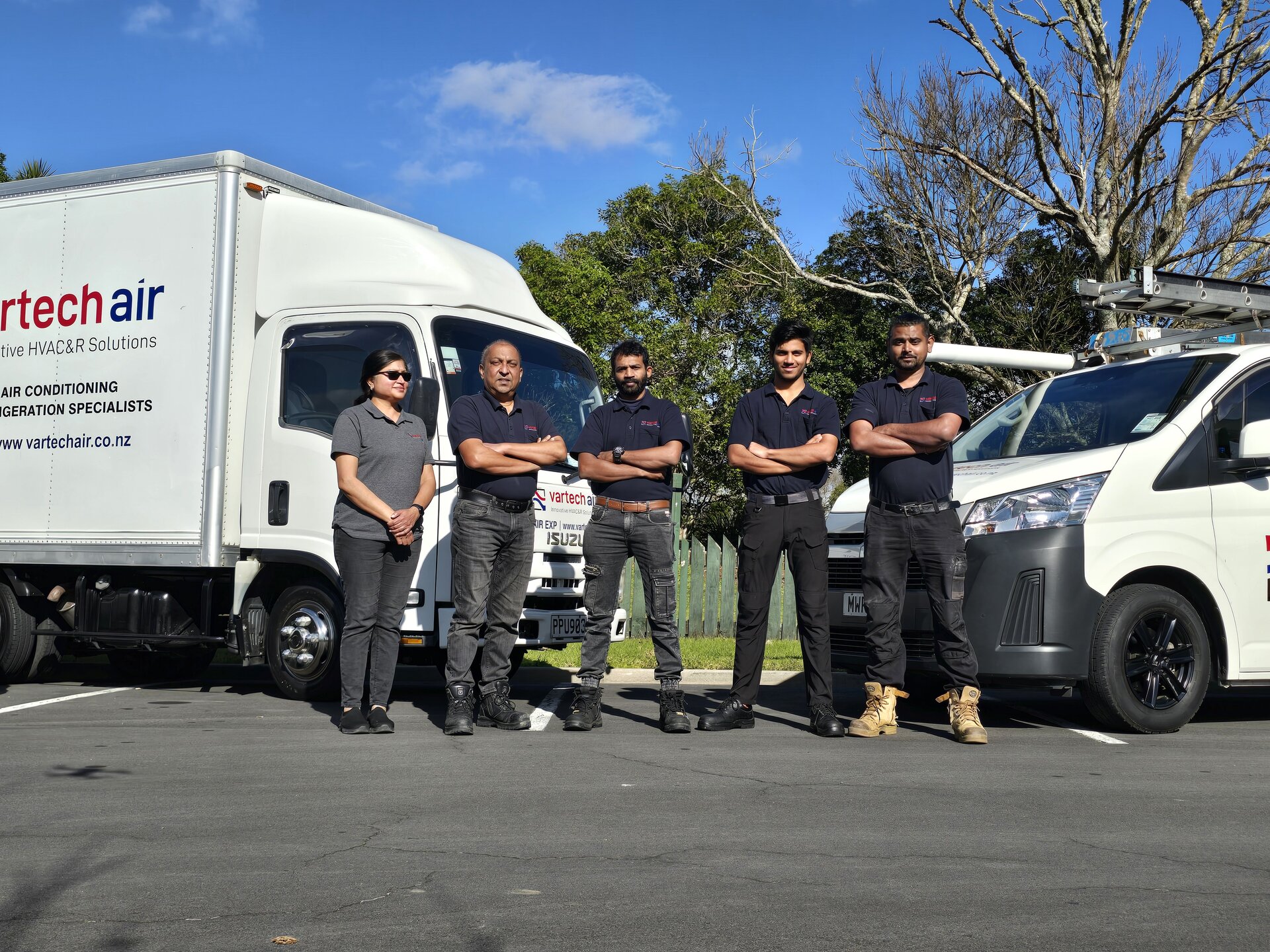
With over 25 years servicing Greater Auckland — from Albany and Takapuna on the North Shore to Auckland CBD, Penrose, Mt Wellington, East Tamaki, and Manukau — Vartech Air Conditioning takes the stress and administrative burden out of commercial HVAC maintenance and BWOF readiness:
- Pre-Audit Compliance Schedule Review: We inspect your building's official Auckland Council Compliance Schedule, map every HVAC, ventilation, fire damper, and extraction asset on site, and identify any compliance gaps before your BWOF anniversary.
- Scheduled Preventive Maintenance Agreements (PMAs): We automate your monthly, quarterly, and six-monthly servicing calendar so no inspection is ever missed.
- Full On-Site Logbook & Digital Asset Reporting: Every visit is documented with technician sign-off, refrigerant compliance logs, electrical safety certificates, and photographic defect reports ready for council or insurance auditors.
- Seamless IQP Form 12A Coordination: We coordinate fire-alarm shutdown testing with your fire contractor and work directly with registered IQPs to deliver your signed Form 12A on time, every year.
- Priority 24/7 Breakdown Response: Contract clients receive priority dispatch and discounted labour rates via our 24/7 emergency air conditioning and refrigeration repair fleet.
8. Frequently Asked Questions: Commercial Building BWOF & HVAC Compliance in Auckland
What is the difference between Specified System SS9 and SS11 on an Auckland Council Compliance Schedule?
Specified System 9 (SS9) covers Mechanical Ventilation or Air Conditioning Systems — including fresh air supply fans, exhaust ductwork, fire/smoke dampers, and central air handling plant that maintain indoor air quality under NZ Building Code Clause G4 and fire safety interlocks. Specified System 11 (SS11) specifically covers Laboratory Fume Cupboards and specialised hazardous extract systems designed to capture and exhaust toxic or flammable vapours safely.
Can any HVAC technician sign a Form 12A for our Building Warrant of Fitness (BWOF)?
No. While qualified HVAC technicians can carry out routine preventive maintenance and filter changes, the annual Form 12A Certificate of Compliance for a Specified System (such as SS9 or SS5 cooling towers) can only be issued and signed by an Independent Qualified Person (IQP) registered on the Auckland Council IQP register for that specific system category.
What happens if an Auckland commercial building misses a scheduled quarterly SS9 inspection?
Under the Building Act 2004, a Form 12A can only be issued if all inspections, maintenance, and reporting procedures stated on the building's Compliance Schedule were completed over the preceding 12 months. If inspections were missed, the IQP cannot legally issue a standard Form 12A; instead, Auckland Council requires a Report of Missed Inspections alongside a Building Warrant of Fitness Report and Declaration (BWRD) demonstrating the system is currently operational and safe.
How much does commercial HVAC BWOF compliance and IQP inspection cost in Auckland?
For a small commercial office or retail tenancy (under 300 m²) with simple split/ducted systems and bathroom/kitchen extract, annual SS9 maintenance and IQP Form 12A sign-off typically costs $750 to $1,650 + GST per year. Medium multi-storey buildings (500–2,000 m²) with VRF/VRV systems, fresh air HRV/ERV plant, and fire damper interlocks average $1,800 to $4,200 + GST per year. Large industrial or high-rise facilities with central chillers and cooling towers (SS5/SS9) range from $4,800 to $12,000+ + GST annually.
Does a single wall-mounted split heat pump require BWOF SS9 sign-off?
Generally, standalone single-room high-wall heat pumps that only recirculate room air do not trigger Specified System SS9 on their own unless they are integrated with a mechanical fresh-air supply duct, connected to the building's fire alarm shutdown matrix, or listed on the building's Compliance Schedule by Auckland Council. However, almost all commercial buildings with central ducted HVAC, mechanical fresh air supply, toilet/kitchen extraction, or fire dampers require SS9 compliance.
How do NZ Building Code Clause G4 and Clause H1 impact commercial HVAC upgrades in Auckland?
Clause G4 (Ventilation) mandates minimum outdoor fresh air supply rates (typically 10 L/s per occupant in commercial offices under AS 1668.2) to prevent CO2 buildup and sick building syndrome. Clause H1 (Energy Efficiency, Fifth Edition) requires commercial HVAC plant in buildings over 300 m² to meet strict minimum Coefficient of Performance (COP) and Energy Efficiency Ratio (EER) thresholds, duct insulation R-values, and motor efficiency standards.
Book a Free Commercial HVAC & BWOF Compliance Audit
Whether your BWOF renewal is coming up in 60 days, your building has received a defective system report, or you want a single reliable partner to manage your commercial air conditioning, mechanical ventilation, and refrigeration across Auckland, our senior technicians are ready to help. Call Vartech Air free on 0800 247 397 or request a site assessment online.
Ready to Upgrade Your Business HVAC?
Get professional HVAC solutions tailored to your needs. Contact our Auckland air conditioning specialists today!
Send Us a Message
Fill out the form below for a free consultation and quote.